Être humain. Quelle notion éthérée ! Si simple, et pourtant si embrouillée par notre monde techno-scientifique. N'est-ce pas ironique que malgré tous les avancées de notre époque, le rôle du médecin comme guide humain soit tout aussi important que jamais (malgré son exclusion des rôles du médecin selon la Faculté) ?Est-ce vraiment pour des conseils cliniques qu'une jeune fille enceinte, un nouveau papa dépassé ou une triste veuve épuisée viennent voir leur médecin ? Plus souvent qu'on ne le reconnait, je crois que la confiance que les patients accordent à leur médecin ne résulte pas de ses compétences cliniques, de sa confidentialité ou même de sa bonne communication. De façon qui dépasse même la portée de la notion de "professionnalisme," il me semble que la base fondamentale de la grande confiance d'un patient en son médecin vient de la compréhension particulière du médecin de la vie humaine, l'être humain, l'humanité.
Aujourd'hui c'était notre deuxième session dans le laboratoire d'anatomie. Ma session de DAC était annulée, donc après la fin du laboratoire j'ai décidé de passer une heure de plus à étudier les cadavres par moi-même. Sans les contraintes du temps, j'ai pu vraiment prendre conscience du fait que les cadavres étaient jadis des personnes vivantes, des êtres humains. Des muscles atrophiés, de la peau lâche et de longs poils sur les bras : celui-ci était surement un vieil homme. Les traces d'une barbe, de larges bras et un gros bedon : celui-là était plus jeune. Mais malgré leurs différences, on peut identifier toutes les mêmes structures sur chacun : le splénius, les érecteurs spinaux, les muscles dentelés - ils sont tous là !
Bien sûr ces réalisations ne m'ont pas surprises, mais quand je suis sorti du laboratoire, j'étais rempli d'une telle joie à chaque fois que je passais quelqu'un. Je ne pensais plus : "Oh ! Les citadins sont toujours tellement pressés !" ou "Je me demande ce qui la tracasse." Non, il n'y avait qu'une chose qui se répétait dans ma tête : "Lui et elle, ils sont parfaitement comme moi. On est sur le même train miraculeux de l'humanité, voyageant vers la même destination - ce qui fait d'eux plus que des pairs, des collègues, des âmes soeurs. Des êtres humains." Les cadavres me rappelaient : Eram quod es, eris quod sum.
Et voilà que j'ai fait un pas vers mon rôle de guide humain. Prochaine étape : assister à un accouchement !
Saturday, October 3, 2009
Guide humain

Thursday, June 25, 2009
Graduation

Monday, March 23, 2009
Liberal Arts[/Higher Education] in Times of Crises: An Open Letter to University Students and Faculty
In the context of an informal chat about current affairs last semester, one of my best professors at Mt.A. declared:
"It must be tough being a student today - I mean, with the environmental and food crises, the financial situation, etc., it must be hard to be studying all sorts of things that won't help solve any of these problems."
I responded that as a pre-med student, it didn't really bother me that my most significant learning happened outside of classes. I was hoop-jumping toward a vocation useful and meaningful even in our troubled times. Still, he did get me thinking. Hence this letter, which is not actually about "higher education in times of crisis," but instead uses today's "crises" as an excuse to question what we're doing here.
So, why is it we're at university?
Although the reasons are innumerable, I think (and hope) that everyone has come here in part to explore: to explore who they are, what they value, what they love, how things are connected, what they could do after Mt.A. This kind of exploration, of course, doesn't happen in one place.
Given its centrality to so many students' journey through university, though, I have no doubt that our classes ought to facilitate it.
Indeed, they all do to a certain extent. Most professors incorporate an element of "This is what academia is like in ___" or "These are the typical issues addressed in ___ and the means by which this is done." Great. But what about the rest?
What kind of exploration do courses offer for the majority of students who aren't actually interested in academia or "the typical issues"?
One might argue that the need to balance exploration with intellectual exercise and the teaching of specific subject matter for a given course limits the possible breadth of a course. Still, that doesn't mean evaluations have to be done exclusively through essays on prescribed topics and through the same old exams.
Real learning can only happen if students are interested in what they're doing and take ownership of it.
This is where things get tricky, because if you ask a professor why they don't give students more opportunities for self-directed learning, they'll probably say they're totally open to it and, in fact, encourage it; students just aren't interested. Of course, if you ask students, professors are likely to get the blame. Not surprisingly, things aren't so black and white; I believe neither group is more to blame than the other.
For truly engaged, self-directed learning to become a reality at Mt.A., we've all got to overcome our familiar but outdated assumptions about each other's expectations.
By no means do I claim to have all the answers; in fact the purpose of this letter is to ask you:
Based on your unique experience, what do you think we can do to increase students' ownership of and engagement in their in-class learning at Mt.A.?
Still, to get you thinking, I'll share a few suggestions of my own.
Assignments
Students, our profs may not be quite as trendy we are, but that doesn't mean they wouldn't be open (perhaps after a little convincing) to our wildest suggestion for an alternative assignments: creating an animé adaption of a story for a lit class, leading a discussion about the modern significance of Greek art for a classics class, composing a rap about epigenetic effects for a biology class, etc.
We've got to stop assuming that we're locked into every exercise proposed by our profs.
If you're not interested in an assignment, step up: propose something creative - but equally challenging - that you would actually enjoy doing, that would allow you to explore the things you want, and that would help you develop the skills you value.
Professors, first off, those lecture notes and syllabi from two, five, fifteen years ago, they've got to be revamped: not just updated to reflect academic developments in your discipline, they've got to change with the times, with current affairs, with students' interests. It's not enough to be open to the diversity of students and their interests, you've to to promote them, embrace them. No matter how hard you try to be friendly and accessible, there will always be a gap in authority and power (especially the power to determine grades) that is intimidating to many students and will deter them from questioning the relevance of your assignments to them individually.
Keeping students interested isn't just about thinking up exciting ways to present material and to evaluate students, it's about engaging students in that very process.
This, I concede, is no easy task; but no one said it would be easy.
Tests & Exams
"Is it going to be on the exam?" The dreaded question: to professors, it's a sign of impending regurgitation by uninterested students; to students, it's a degrading but necessary submission to the System. What's it really about?
First off, even compared to leading universities in the U.S. (where are a regular student covers 12 credits per 15-week semester), we cover a lot of material in our 12-week semesters! In fact, I think we cover so much that a typical student with any semblance of a balanced lifestyle rarely has time to reflect on course material at their leisure.
With all the different courses and activities competing for our time, the average student simply can't afford to ponder course material beyond what will be evaluated.
I'm sure both students and professors would be happier if students could simply study course material with a focus on that in which they're interested - not just in terms of content, but also in terms of connections. For that to become a reality though, students need to know that that accomplishment will be worth something in evaluations. That in turn will only happen if we demand it: an open-ended question about connections as an option in the long-answer section of an exam, an optional open-ended supplementary assignment, whatever! I'm not suggesting that this kind of individual knowledge and understanding replace that of basic principles on which courses are based, but rather that they supplement this prescriptive core.
If a creative approach to evaluation were implemented, students wouldn't have to worry about losing a few marks on (to them, insignificant) details because they could count on making up for it with the learning that was important to them.
Engaged learning isn't a utopia; it's a vision - a vision which we've all got to keep nurturing through discussions, blog posts, newspaper articles, videos, whatever you like. I know the vision I've outlined in this letter is very rough and incomplete. This is partly because I don't have all the answers, but mostly because I know the vision isn't just mine. So if you do share this vision, I challenge you to put in your two cents, and together, who knows how much we could save...
Tuesday, March 10, 2009
Maritime Elation
How I'm going to miss the Maritimes!
Two days before my first interview for medical school (one day before my flight out), I thought it was time to find something to wear. I'd marked four men's clothing stores I'd found in the yellow pages on a map of Moncton and after my 8:30 class, I set out on the bus.
Tip Top was the only store I knew would actually carry the kind of clothes I was looking for; I chose the others based on their names: Zachary Samuels Men's Clothier and Custom Shirts, Up in Style, and Colin D's Boutique. Zachary Samuels sounded like my best bet so I decided to start there. I passed Up in Style on the way (thinking I might stop there first, depending on what it looked like) but it turned out to be a sk8 shop.
When I arrived at Z.S. the owner (the only staff person there) was helping another client. I told him I needed a suit ready in 24 hours; he sat me down on a leather couch and served me a cappuccino. After a couple of hours of chatting, we had a suit, shirt and tie picked out. The tie and two pairs of socks were on the house.
I had brought my own dark brown dress pleather dress shoes (which were in need of some minor mending) to try on with the “midnight navy” (i.e. practically black) suit but apparently, that simply would not do. I needed black shoes, or perhaps cognac ones. Since I had a choir concert coming up at which I would need black shoes and knew I'd get good use of them, I conceded.
So that I would have my suit on time, he had to take it immediately to the tailor's. He shut the shop and dropped me off at a shoe store on the way. We agreed that I would find my way by to the store the next day around 1 p.m. and he would properly pack my suit (so it wouldn't wrinkle) and take me to the airport from there. There were some great sales at the shoe store and, though I didn't get the same service, I quickly found a nice pair.
Since the next bus back to Sackville wasn't until 8:15 p.m. and it was only 2 p.m. by that time, I decided to get a few more things done. First, I walked over to the Taj Mahal, the famous Indian restaurant in Moncton at which I'd never eaten and I had a late but scrumptious lunch. Before leaving, I asked the waitress if she knew of anywhere where I could get a nice haircut. She suggested a few places and I tried to follow her directions to the most promising place. Not only did I get lost and have to ask a homeless person for directions, but when I got there, it also wasn't quite up to my med-school-interview standard. I started walking in the other direction trying to recall the location of the other shops the waitress had mentioned.
When I found myself all the way into Dieppe, I decided I'd have to settle for whatever I could find in the mall there. It was a tough call: the salon looked pretty classy, but totally focussed on women and esthetics. I took a gamble – and drew the short straw, or so I thought...
Yes, they could give me a cut right away. Right this way. I sat down and a boy with emo hair, no older than 18, came and set me up. I explained my situation to him: I needed something professional enough for my interviews but didn't want to go so short that I would lose my curls. No clippers, we decided. It was the most meticulous haircut I'd ever gotten and, in the end, it was just right.
Next, I took a bus back downtown and looked for a little café where I could spend a couple hours reading as I waited for 8:15 to come. I found The Old Triangle, my favourite Irish pub that was offering two free oysters with a pint of Guinness: how could I resist?
Taking a break from my book on medical ethics, but continuing to shower the couple of oysters in my stomach with Guinness, I unconsciously and longingly stared at the oyster bar; its bartender (the pub's owner) offered me two more on the house. After that, I felt like I had get something else – and I guess I was a little hungry: I ordered a bowl of mussels. A while later, an Acadian couple arrived and sat at the table next to mine.
Perhaps intrigued by my outsider's appearance, they asked me all about what I was doing in Moncton, where I was from, where I learned French, what I wanted to do with my life, etc. They were from Cap Pelé, not far from Sackville and he was a highway supervisor: he was responsible for snow and (especially those past few days) ice removal. He also had a great hankering for some oysters but didn't want any Guinness.
He offered to buy me another pint, but I wasn't feeling up to it. Instead, after much soul-searching about how badly I wanted more oysters, I offered him a coupon for two, which someone had given me on his way out: apparently, that man liked Guinness more than oysters. By then, it was nearing the time for me to get going to the bus station, so I asked for the bill. A moment later, the waiter returned and told me my neighbours were getting the bill for me. I thanked them and we said our goodbyes, committing to keep an eye open for each other.
The bus ride home was uneventful, except perhaps for the realization that this was probably one of the last times in a while that I would be filled with Maritime elation.
Monday, February 9, 2009
Une crise économique, c’est sexiste, dites?
http://www.radio-canada.ca/nouvelles/economie-affaires/la_crise_et_vous/index.asp
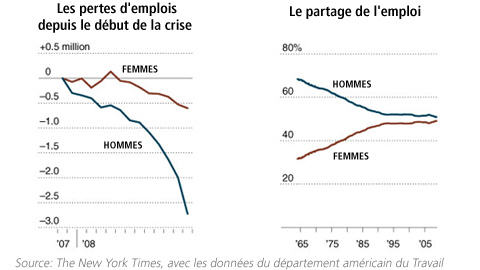
Par: Nicolas (pas Nicholas) Duguay (pas Dubé)C’est étrange, mais ce matin, en prenant connaissance des plus récentes données sur l’emploi aux États-Unis, et tout particulièrement celles comparant les pertes d’emplois chez les hommes et les femmes, c’est à la vieille série télé « Papa à raison » que je pensais...
Je pensais à ça, car c’est justement l’Amérique de cette série-là, une Amérique riche et suffisante dirigée par des hommes blancs tout aussi riches et suffisants, qui en prend pour son rhume ces temps-ci.
En l’espace de quelques mois, l’un des premiers Commandements du capitalisme à l’américaine, qui veut que l’État se tienne à l’écart de l’économie, a été bafoué à coup de milliards de dollars de fonds publics.
Et maintenant, la crise économique qui dévaste le marché de l’emploi est en train de faire en sorte que pour la première fois de l’histoire américaine les femmes pourraient bientôt surpasser en nombre les hommes sur le marché du travail...
Voilà seulement quelques décennies, comme nous pouvons le voir dans le tableau ci-bas, la part des femmes sur le marché du travail américain ne dépassait guère les 30 %.
Aujourd’hui, hommes et femmes sont au coude à coude et si la tendance observée depuis le début de la récession se maintient, ne serait-ce que quelques mois encore, nous allons rapidement assister à une dominance féminine sur le marché du travail.
Hécatombe pour les secteurs « masculins »
Les experts expliquent ce revirement historique en arguant de la nature des emplois les plus mis à mal par la crise.
Comme l’explique le New York Times dans un article sur le sujet paru aujourd’hui même, ce qui se passe n’a rien à voir avec la lutte pour l’égalité des sexes, mais plutôt avec l’endroit où tombe la hache...
En effet, il appert que 82 % des emplois perdus depuis décembre 2007, date officielle du début de la récession américaine, étaient occupés par des hommes.
Pourquoi?
Tout simplement parce que les secteurs économiques sur la ligne de front de la crise, le secteur manufacturier et celui de la construction, sont des secteurs où, traditionnellement, l’essentiel de la main-d’oeuvre est masculine.
Et tout ceci, contrairement à ce qu’on aurait pu penser, est loin d’être une bonne nouvelle...
Pas parce que l’auteur de cette chronique pense que c’est une tragédie économique d’avoir davantage de femmes au travail que d’homme, mais plutôt parce que les emplois occupés par les femmes sont souvent moins « intéressants » que ceux des hommes.
« Intéressants » ?
C’est-à-dire que l’on retrouve encore aux États-Unis une plus grande proportion de femmes que d’homme qui occupent des emplois à temps partiel, des emplois qui bien souvent ne sont accompagnés d'aucune assurance médicale et qui n’offrent pratiquement aucune sécurité d’emploi.
Et même lorsqu’elles travaillent à temps plein, les statistiques gouvernementales démontrent que les femmes américaines ne gagnent encore en moyenne que 80 % de la paye de leurs homologues masculins travaillant autant.
Sunday, January 25, 2009
Maybe you shouldn't be reading this...
From
